


 English
  عربى
عربى  中文简体
中文简体


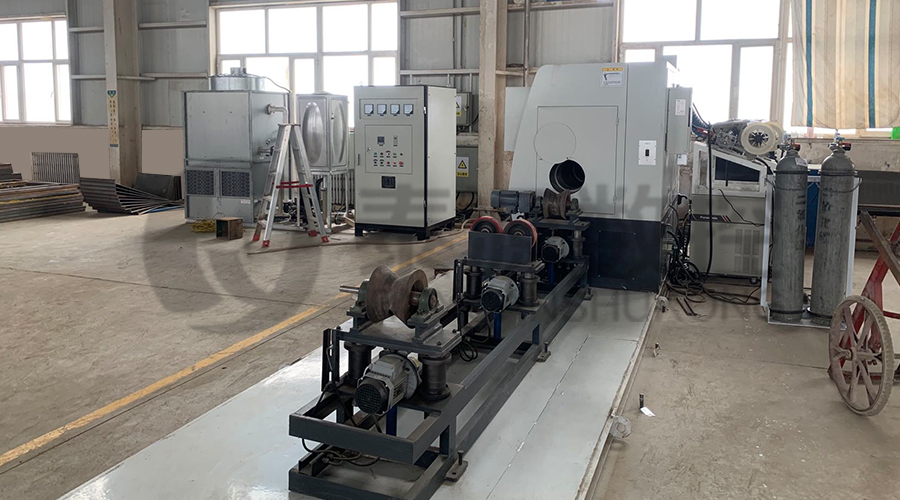
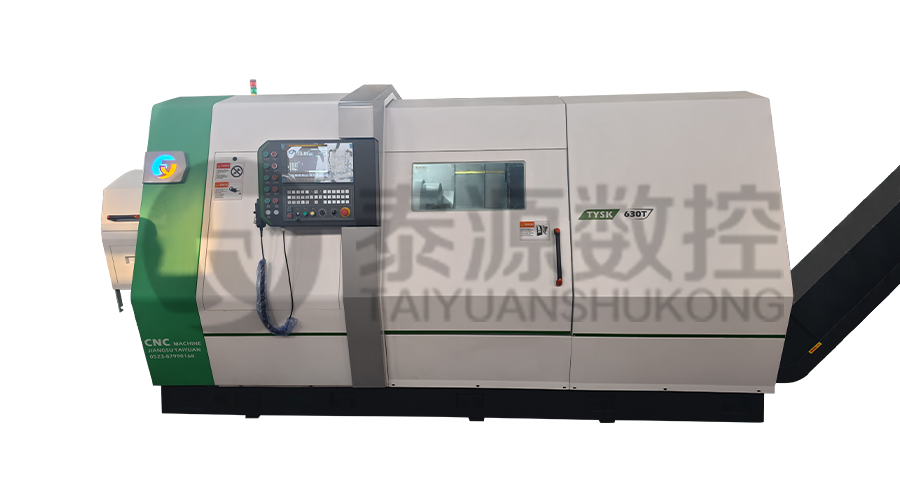
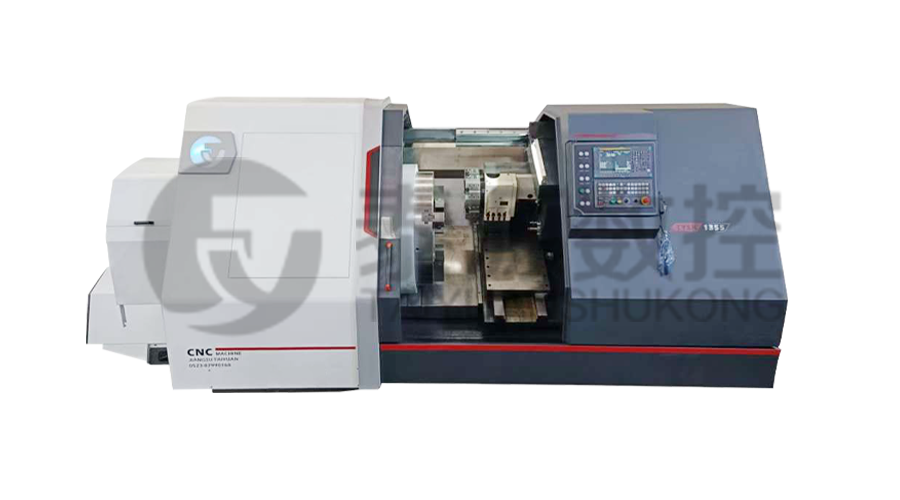
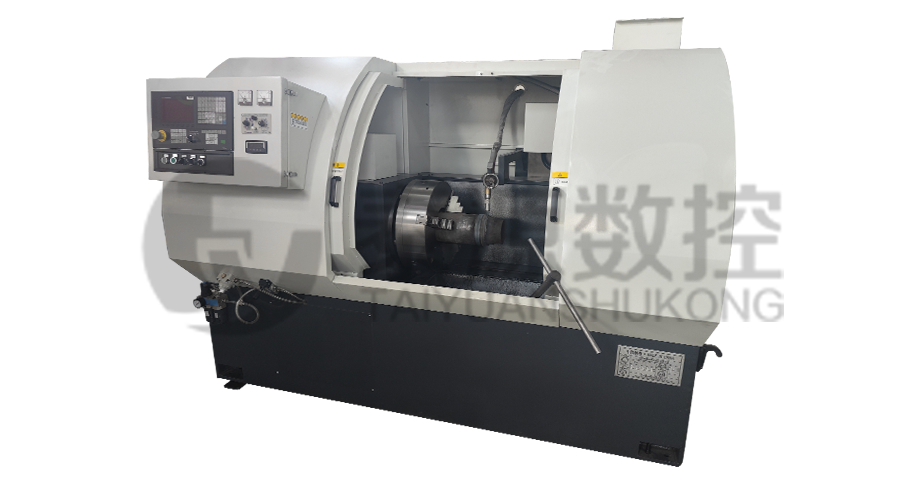
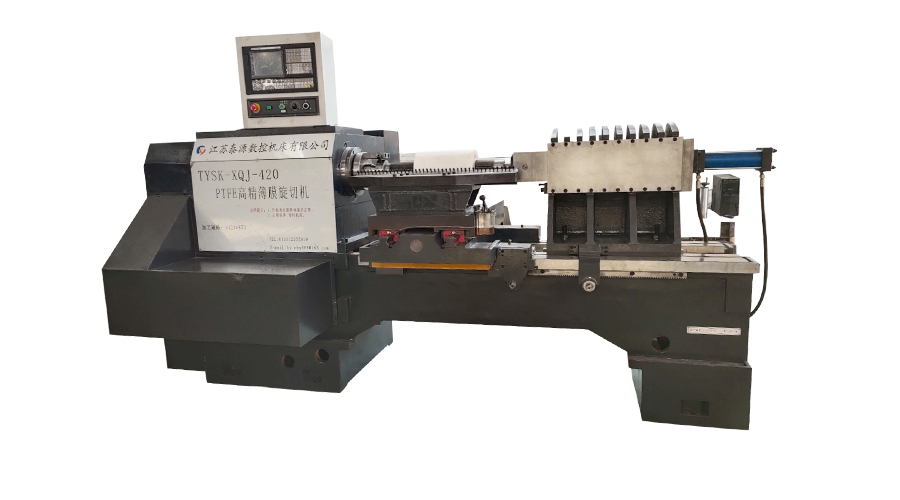
An automatic pipe threading lathe machine is a CNC or mechanically automated turning centre specifically engineered to cut precise external or internal threads onto pipe ends — continuously, repeatably, and without manual repositioning of each workpiece between cycles. These machines eliminate the operator-intensive steps of conventional manual lathes: loading, chucking, tool positioning, thread cutting, inspection, and unloading are all executed under programmable control, reducing cycle times from 4–8 minutes per pipe end on a manual machine to 45–90 seconds on a fully automated line. For oil country tubular goods (OCTG), plumbing pipe, conduit, and structural tube manufacturers producing thousands of pieces per shift, an automatic pipe threading lathe machine is the defining productivity and quality investment in the production line.
What an Automatic Pipe Threading Lathe Machine Does
At its core, a pipe threading lathe machine cuts helical grooves — threads — into the outer or inner surface of a pipe end to a defined pitch, depth, taper, and form. The thread form must meet dimensional standards (API 5B for oil country pipe, ASME B1.20.1 for NPT plumbing pipe, ISO 228 for parallel threads) within tolerances measured in thousandths of a millimetre. What distinguishes the automatic version from a conventional threading lathe is the integration of workpiece handling, clamping, cycle sequencing, and in-process gauging into a single uninterrupted production flow.
Core Machine Functions in Sequence
- Automatic pipe loading: Pipes are fed from a V-cradle magazine, roller conveyor, or bundle loader onto an inclined entry ramp. A hydraulic or servo-driven advancing mechanism pushes each pipe forward until it contacts the chuck face, triggering the clamping sequence. This loading step — which takes 8–15 seconds on a well-designed automatic system — replaces the 60–120 seconds of manual handling per pipe that a two-operator conventional lathe requires.
- Hydraulic power chucking: The pipe is gripped by a three-jaw or four-jaw hydraulic chuck at a clamping force precisely calibrated for the pipe wall thickness and material grade. Under-clamping allows vibration that destroys thread form accuracy; over-clamping deforms thin-wall pipe. Automatic machines use programmable clamping pressure — typically 40–120 bar — that can be set per job and stored in the machine's parameter library.
- Facing and chamfering: Before threading begins, the pipe end face is turned flat (faced) and the outer edge chamfered to a defined angle — typically 15–30 degrees. These operations remove mill scale, correct end squareness, and create the lead-in geometry that guides the mating fitting onto the thread. On a manual lathe these are separate, timed operations; on an automatic machine they are executed in the same tool cycle as the threading pass.
- Thread cutting: The threading tool — a carbide insert in a defined thread form geometry — traverses the rotating pipe end at a feed rate synchronised to the spindle speed to produce the required thread pitch. Taper threads require the carriage to move simultaneously in X (radial) and Z (axial) axes under CNC control. Multiple threading passes remove material progressively to the final thread depth, protecting tool life and controlling chip formation.
- In-process gauging: A ring gauge or electronic probe checks the finished thread after the final cutting pass while the pipe remains chucked. Out-of-tolerance threads are flagged and the machine halts for operator intervention rather than passing defective parts to the next operation. This closed-loop gauging eliminates the sampling-based inspection used on manual lines, where statistically significant numbers of defective threads reach assembly before being detected.
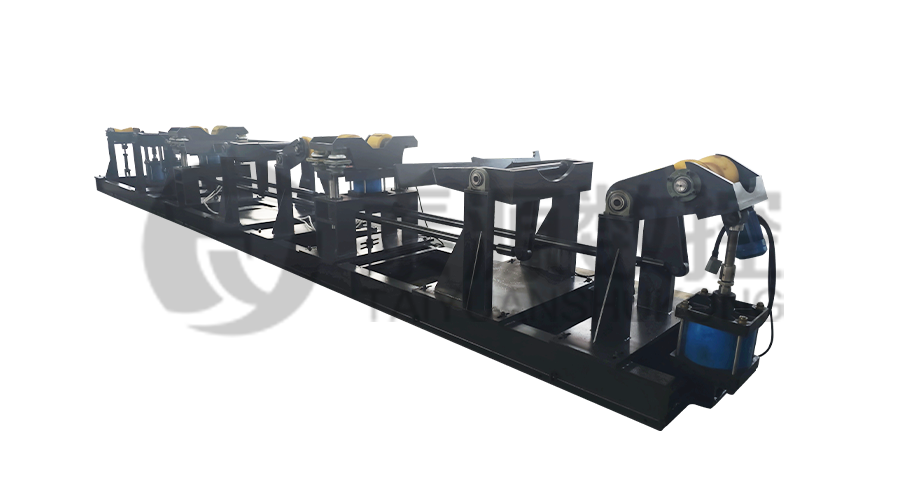
- Automatic unloading: The chuck releases and a retractable unloading arm, outfeed roller, or tilting table moves the threaded pipe to the outfeed conveyor. For pipes that require threading at both ends, a pipe rotation and repositioning mechanism presents the unthreaded end to the chuck for the second threading cycle without requiring the pipe to leave the machine.
Machine Configurations and What Each Covers
Automatic pipe threading lathes are not a single product type — they span a wide range of configurations matched to pipe diameter, wall thickness, pipe length, required output rate, and thread standard. Understanding the main configurations prevents specifying a machine that is correctly automated but geometrically mismatched to the production requirement.
| Configuration | Pipe Diameter Range | Typical Spindle Power | Cycle Time | Primary Application |
|---|---|---|---|---|
| Compact single-spindle CNC | 15 – 114 mm (0.5 – 4.5 in) | 7.5 – 15 kW | 45 – 75 sec/end | Plumbing, EMT conduit, small OCTG |
| Medium-duty single-spindle CNC | 60 – 273 mm (2.4 – 10.75 in) | 18 – 37 kW | 60 – 90 sec/end | Line pipe, casing, structural tube |
| Heavy-duty single-spindle CNC | 177 – 508 mm (7 – 20 in) | 45 – 90 kW | 90 – 180 sec/end | Large-diameter OCTG, piling, subsea pipe |
| Twin-spindle simultaneous | 15 – 273 mm | 2 x 15 – 45 kW | Single cycle threads both ends | High-volume short-pipe production |
| Multi-station rotary index | 15 – 168 mm | Multiple spindles | Parts per minute rather than per cycle | Mass production of short nipples and fittings |
Key Technical Specifications That Define Machine Capability
When evaluating or specifying an automatic pipe threading lathe, the following parameters determine whether the machine will meet production requirements — and misunderstanding any one of them leads to either under-specified equipment that becomes a bottleneck or over-specified equipment that does not recover its capital cost.
Spindle Speed Range and Power
Thread cutting is a relatively low-speed operation compared to general turning. Carbide threading inserts in carbon steel pipe typically run at 60–120 m/min cutting speed — for a 114 mm diameter pipe, this translates to 170–340 RPM. For stainless or chrome-moly alloy pipe, cutting speeds drop to 30–60 m/min to manage heat and tool wear. The spindle must deliver rated torque at these low speeds, which requires machines with gearbox or direct-drive servo spindles rather than simple belt-drive motors that lose torque at low RPM. Spindle power requirements scale directly with pipe diameter and material hardness — threading 508 mm diameter pipe in P110 grade steel requires 75–90 kW of available cutting power at the spindle.
Carriage Travel and Bed Length
The threading carriage must traverse the full engaged thread length plus an approach and run-out clearance distance. API round threads on 10.75-inch casing have an engaged thread length of approximately 100 mm — the carriage Z-axis travel must accommodate this with margin. For pipes requiring a combined facing, chamfering, and threading cycle, the total required Z travel is typically 150–300 mm depending on pipe diameter. The machine bed must be long enough to support the pipe without the unsupported overhang causing vibration — for 12-metre pipe joints, this typically means a bed length of 13–14 metres with steady rest supports at 2–3 metre intervals.
Thread Standards and CNC Program Library
A fully capable automatic pipe threading lathe should hold a parametric CNC program library covering all thread forms the production line requires:
- API 5B threads (round and buttress): The mandatory standard for OCTG — tubing, casing, and drill pipe connections. API round threads (API RD) have a 60-degree included angle, 0.0625 inch/inch taper, and pitch ranging from 8 TPI for small tubing to 4 TPI for large casing. API buttress threads have an asymmetric form — a 3-degree stab flank and 10-degree load flank — that requires precise independent control of both flanks during cutting.
- NPT (ASME B1.20.1) and NPTF: The dominant standard for US plumbing and gas pipe applications. 0.75-inch per foot taper; pitches from 27 TPI for 1/8-inch pipe to 8 TPI for 2-inch and larger. NPTF (dryseal) requires tighter tolerances on crest and root truncation than standard NPT.
- BSP (ISO 228 and BS 21): The dominant European plumbing thread standard, used in BSPP (parallel) and BSPT (taper) forms. 55-degree Whitworth thread form rather than the 60-degree unified form of NPT — requires a dedicated threading insert and cannot be cut with the same tooling used for NPT.
- Premium or proprietary connection threads: Major pipe connection manufacturers (Tenaris, Vallourec, NOV) offer premium connections with complex multi-step thread forms and precision seal geometries that require CNC programs specific to each connection type, often supplied by the connection licensor as encrypted program files that the machine executes without exposing the geometry to the operator.
Automatic Loading and Unloading — The Productivity Multiplier
The threading spindle is rarely the constraint on an automatic pipe threading line — the limiting factor is almost always the time taken to load, position, and unload the workpiece. A machine that cuts a thread in 60 seconds but requires 90 seconds of manual handling between cuts is producing at an effective rate no better than a manual lathe with an experienced operator. The automatic loading and unloading mechanism transforms this equation by running loading and unloading operations concurrently with the threading cycle on the previous piece — so that when threading completes, the next pipe is already positioned and ready to chuck.
| Handling System Type | Pipe Length Capability | Load/Unload Time | Operator Requirement | Best For |
|---|---|---|---|---|
| V-cradle gravity magazine | Up to 6 m | 8 – 12 sec | Periodic magazine refill only | Short pipe, high volume |
| Servo-driven roller conveyor | 3 – 13 m | 10 – 18 sec | Infeed stacking; monitoring | Standard OCTG lengths (9 – 13 m) |
| Overhead gantry loader | 3 – 18 m | 15 – 25 sec | Bundle management at infeed | Heavy large-diameter pipe |
| Walking beam conveyor | 6 – 18 m | 12 – 20 sec | Infeed and outfeed monitoring | High-volume long pipe production |
| Robotic arm with gripper | Up to 12 m (with support) | 20 – 35 sec | Minimal — exception handling only | Flexible mixed-product production cells |
Production Rate and ROI Calculation
The business case for an automatic pipe threading lathe is built on three quantifiable improvements over manual threading operations: throughput rate, labour cost per piece, and scrap rate reduction. Realistic production scenarios illustrate the scale of these improvements:
Throughput Comparison — Manual vs. Automatic
A skilled two-operator team on a manual threading lathe threading 4.5-inch diameter API line pipe achieves approximately 80–100 pieces per 8-hour shift, limited primarily by the loading, chucking, and gauging time between cuts. An automatic threading lathe with roller conveyor loading threading the same product at a 75-second cycle time produces 384 pieces per 8-hour shift running at 90% availability — a 3.8 to 4.8-fold throughput increase from a single machine serviced by one monitoring operator rather than two active operators.
Scrap Rate Reduction
Manual threading operations on well-maintained equipment produce scrap rates of 1.5–3.5% from dimensional non-conformances, primarily due to tool wear progression between manual inspection intervals and operator variability in setup. Automatic machines with in-process gauging and automatic tool wear compensation maintain scrap rates below 0.3% in well-documented production environments. For OCTG pipe at $40–120 per piece, a scrap rate reduction from 2.5% to 0.3% on a 1,000-piece per day line represents $880–2,640 per day in recovered material value.
Selecting an Automatic Pipe Threading Lathe — Decision Criteria
- Pipe diameter range and wall thickness: Define the minimum and maximum pipe OD and wall thickness in your product mix. The machine must chuck reliably at both extremes — thin-wall pipe requires lower clamping pressure and different jaw configurations than heavy-wall pipe of the same OD. Specifying for the average rather than the extremes results in a machine that cannot run the full product range without retooling delays.
- Thread standards required: List every thread form the machine must produce, including any premium connection licenses you hold or plan to acquire. Verify with the machine builder that each thread form is supported by a validated CNC program, not just a claim of compatibility. Request sample parts for qualification before machine acceptance.
- Required output rate and shift pattern: Calculate the required pieces per shift from your production plan, then divide by the expected availability (typically 85–92% for a well-maintained CNC threading lathe) and the cycle time to determine whether one machine meets the requirement or whether two machines in parallel are needed. Over-specifying a single machine to achieve higher cycle times than needed is less flexible than two standard machines that provide redundancy.
- Pipe length and weight handling: Confirm that the loading system is rated for the heaviest pipe in your mix. A 13.375-inch diameter, 12-metre long P110 casing joint weighs approximately 2,100 kg — the loading conveyor, steady rests, and outfeed system must all be rated for this mass with an appropriate safety margin.
- Coolant system specification: Threading generates significant heat and chip volume. A high-pressure through-coolant system (70–100 bar, 40–60 L/min flow rate) delivers cutting fluid directly to the tool-workpiece interface, extending carbide insert life by 40–80% compared to flood coolant and significantly improving chip evacuation on deep thread engagement. Verify that the coolant system is matched to the machine's thread-cutting parameters, not merely adequate for general turning.
- Control system and Industry 4.0 connectivity: Modern automatic threading lathes should provide OPC-UA or MTConnect data output for integration with factory MES and quality management systems. In-process gauging data, tool wear parameters, cycle times, and alarm logs should be logged automatically and accessible for SPC analysis — this data connectivity is increasingly a customer requirement in OCTG supply chains where API Q1 and Q2 quality management standards apply.