



 English
  عربى
عربى  中文简体
中文简体

Reminder information

Feb 12, 2026
Content
In the high-stakes environment of oilfield exploration, the longevity of drill pipes and tool joints is directly dependent on the quality of hardbanding applied to resist downhole abrasion. A semi-automatic wear-resistant band welder has become an essential asset for service shops looking to balance precision with operational efficiency. Jiangsu Taiyuan CNC Machine Tool Co., Ltd., established in 2003, stands at the forefront of this technology, providing specialized machinery for the national petroleum equipment manufacturing industry. Our equipment is engineered with the rigidity and driving power required to handle advanced metallurgy, ensuring that tool joints and centralizers meet the rigorous demands of global oilfields.
One of the most frequent technical inquiries is how to use a semi-automatic welder for tungsten carbide hardbanding. Tungsten carbide (WC) alloys are notoriously difficult to apply because they consist of hard particles suspended in a softer metallic matrix. A semi-automatic wear-resistant band welder must provide precise control over the heat input to prevent the "sinking" or dissolving of the carbide grains into the weld pool. Jiangsu Taiyuan CNC Machine Tool Co., Ltd. designs machines with stable precision retention, allowing for the consistent bead profile necessary to lock these high-hardness particles in place.
While manual welding often leads to uneven distribution of carbides, the semi-automatic system ensures a uniform concentration, which is critical for maximizing the wear-resistance of drill pipe joints.
| Feature | Semi-Automatic Band Welder | Manual Arc Welding |
| Carbide Distribution | Homogeneous (Controlled travel speed) | Inconsistent (Operator dependent) |
| Heat Input Control | High Precision (Reduces WC dissolution) | Variable (Risk of brittle heat-affected zone) |
| Bead Uniformity | High (CNC-guided surfacing) | Moderate to Low |
For directional drilling, non-magnetic drill collars are utilized to avoid interference with MWD (Measurement While Drilling) tools. A common question arises: can a semi-automatic wear-resistant band welder apply non-magnetic alloys? These alloys, typically high-chromium and high-nickel, require specific cooling rates and shielding gas coverage. The semi-automatic wear-resistant band welder produced by our company features advanced CNC milling and surfacing capabilities that allow for the specialized welding parameters required by non-magnetic wires.
Standard magnetic alloys are easier to apply but will compromise the sensitivity of navigational sensors; therefore, the precision of a semi-automatic wear-resistant band welder is a necessity for the integrity of non-magnetic hardbanding alloys.
| Performance Metric | Non-Magnetic Hardbanding | Standard Cr-Fe Hardbanding |
| Magnetic Permeability | < 1.01 (Safe for MWD tools) | High (Causes sensor interference) |
| Welding Difficulty | High (Requires strict heat control) | Standard |
| Application Method | Best with Semi-Auto/CNC for shielding | Adaptable to most methods |
The technical superiority of our machinery lies in its structural design. Jiangsu Taiyuan CNC Machine Tool Co., Ltd. products are characterized by being "simple in structure, strong in specificity, and few in failure points." When operating a semi-automatic wear-resistant band welder, the machine must maintain rigidity under high-duty cycles. This is particularly important for improving drill pipe joint durability with semi-automatic welding, where pockmarks or inconsistencies in the band can lead to premature failure in the borehole.
Many procurement managers ask: is a semi-automatic wear-resistant band welder cost-effective? By automating the surfacing process, production efficiency is significantly increased compared to traditional methods. Our tools are widely used by industry leaders like Baosteel and Shengli Oilfield, as well as international partners in the United States, Japan, and Azerbaijan. The ability to switch between different alloy types—from tungsten carbide to non-magnetic bands—makes the semi-automatic wear-resistant band welder a versatile investment for any energy equipment facility.
Furthermore, why semi-automatic welding is better for wear-resistant bands is demonstrated in the reduction of rework and the "long precision retention time" of the finished product, which reduces the total cost of ownership for the end-user in the oil field.
Yes. The semi-automatic wear-resistant band welder from Jiangsu Taiyuan is designed with adjustable fixtures to accommodate various sizes of drill pipes, joints, and centralizers.
Our welding systems are compatible with both. Gas-shielded flux-cored wires are often used for non-magnetic alloys to ensure a cleaner weld pool, while open-arc is common for standard hardbanding.
The system allows for controlled pre-heating and post-welding cooling rates (often used in conjunction with auxiliary heating tools), which is vital for managing the stresses in carbide-rich overlays.
Adhering to our principle of "simple in structure," the control system is designed to be intuitive while providing the high technology needed for "specialization and refinement" in drilling equipment.
Jiangsu Taiyuan CNC Machine Tool Co., Ltd. has obtained GBT and ISO quality system certifications, ensuring that our products are "reliable in quality and high in technology."
Related Products
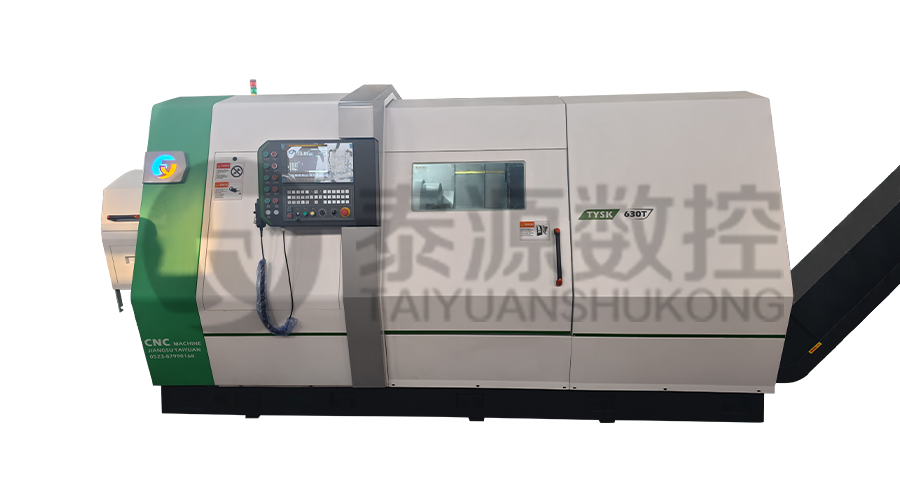 Model:TYSK-630T Drill Pipe, Joint & Coupling Lathe
The machine adopts a FANUC CNC system with stable processing accuracy and flexible programming functions to ensure that the processed parts meet strict industry standards. The high torque and heavy-load design can cope with long-term continuous work and has strong durability.
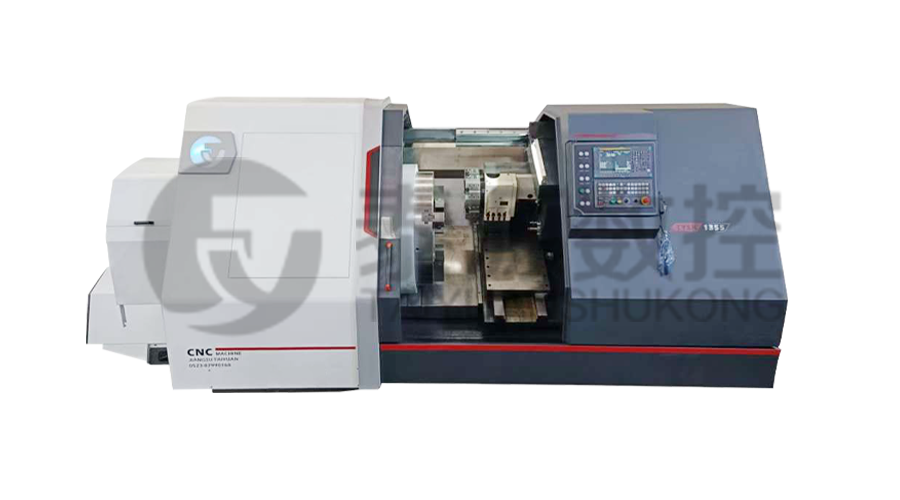 Model:TYSK-1355 Oil Pipe Processing Lathe
The machine adopts a FANUC CNC system with stable processing accuracy and flexible programming functions to ensure that the processed parts meet strict industry standards. The high torque and heavy-load design can cope with long-term continuous work and has strong durability.
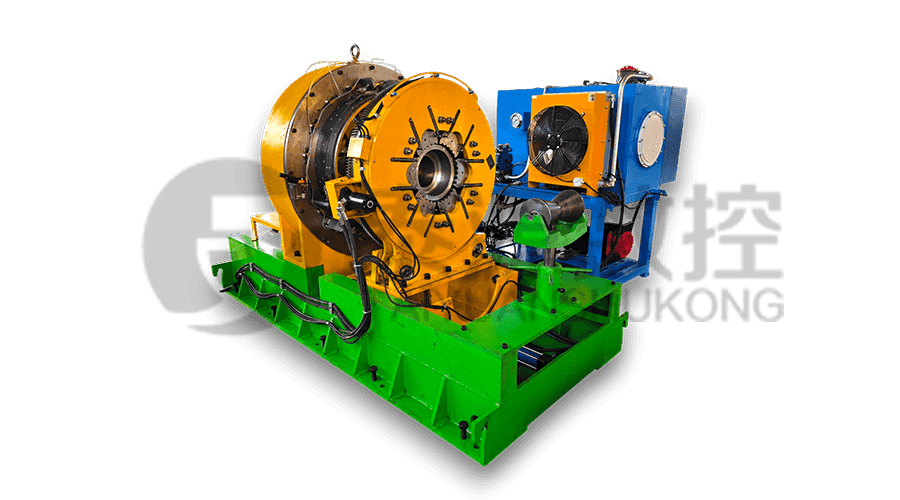 Series:TYSK-NKJ Screw-on machine/Casing and tubing coupling bucking unit
The machine uses a hydraulic motor, mechanical floating mechanism, and real-time torque detection, adapts to material bending, and prevents material deformation. Auxiliary machines are configured to help with semi-automation.
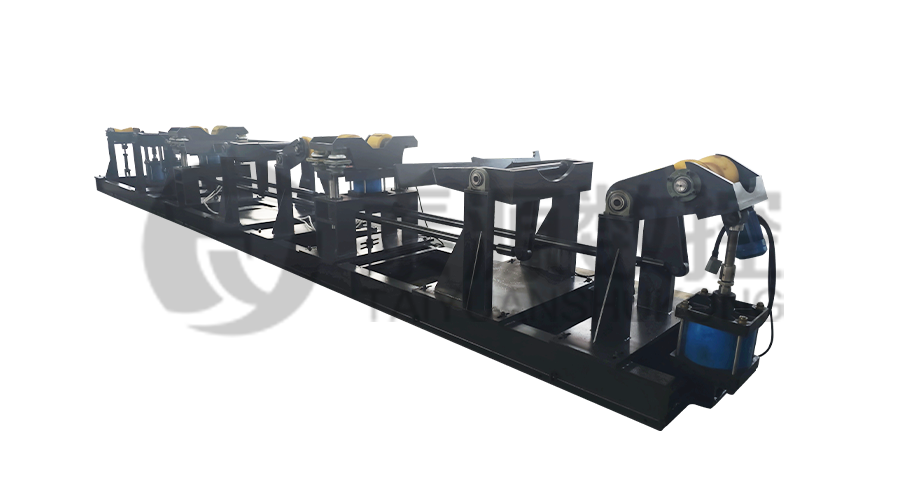 Long, heavy material solutions Automatic loading and unloading mechanism for pipe threading
The special flexible support mode can effectively reduce the influence of workpiece bending on processing and improve the yield. Strictly matching with our pipe threading lathe.
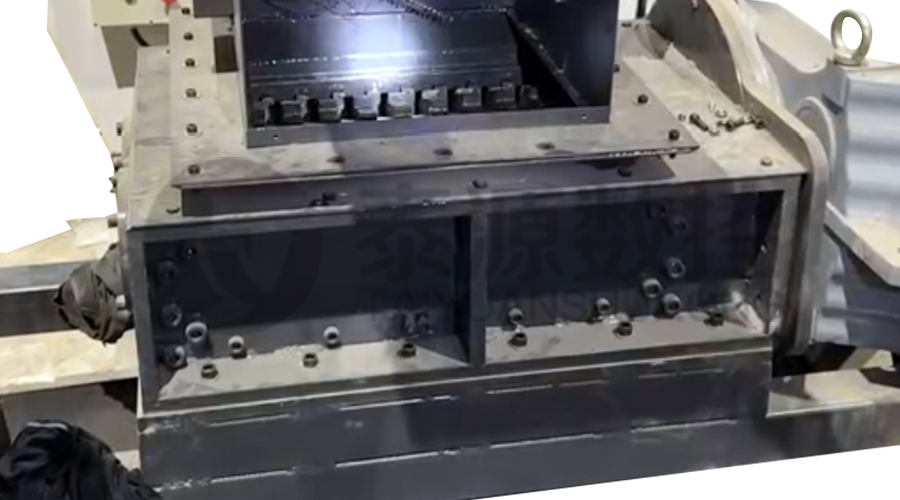 Modular Iron Chip Crusher High strength crusher for chip
The blades are made of high-strength materials and reasonably placed at the exit of the chip extractor to break the clump iron chips.Reduce the risk of rollback and improve waste frame utilization.
Series:TYSK-HB Semi-automatic wear-resistant band welder
Applicable to ARNCO 100XT, 200XT, 300XT. Support φ1.2-2.0 cored or solid wire surfacing welding.Can be equipped with single gun spray welding and double gun spray welding two ways. Support PLC or CNC system control.
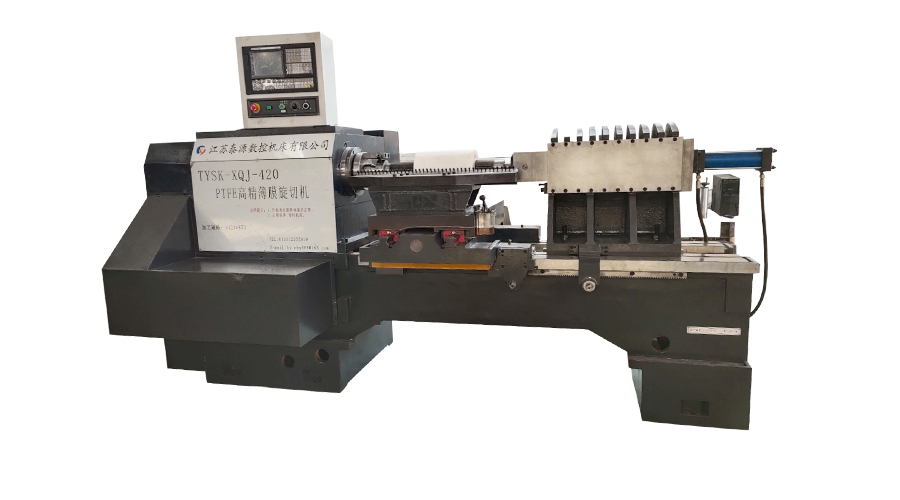 Model:TYSK-XQJ-550 Medium & Large PTFE Film Skiving Machine
Designed to process blanks with a maximum diameter of 550 mm and a maximum length of 1000 mm. We can also customize according to the needs of users. Friendly change speed and thickness with CNC.
