



 English
  عربى
عربى  中文简体
中文简体

Reminder information

Dec 12, 2025
Content
The integrity of any oil or gas well hinges on the reliability of the downhole connections. The Casing And Tubing Coupling Bucking Unit Lathe is a highly specialized piece of equipment responsible for achieving the precise make-up torque on couplings to be used on Oil Country Tubular Goods (OCTG). Failure to apply the correct torque—whether over-torquing, which damages the thread, or under-torquing, which leads to leakage—results in catastrophic connection failure, loss of well integrity, and significant financial loss.
For B2B buyers and production engineers, specifying a bucking unit requires evaluating its capacity for consistent, repeatable precision across a broad range of products. Jiangsu Taiyuan CNC Machine Tool Co., Ltd., established in 2003 as a production base for special machine tools in the national petroleum equipment manufacturing industry, provides equipment with high technology, strong rigidity, and exceptional precision retention. Our experience in specialized equipment, including the Casing And Tubing Coupling Bucking Unit Lathe and drill pipe production lines, ensures that our solutions meet the rigorous demands of global oilfields, geology, and mining operations.
The operational applicability of a Casing And Tubing Coupling Bucking Unit Lathe is determined by its mechanical design limits, including spindle size, through-bore diameter, and the clamping mechanism's load capacity. A modern unit must accommodate a wide oilfield pipe coupling size range bucking unit, typically from two and three eighths inches to thirteen and three eighths inches in diameter, and handle the coupling lengths associated with both API and premium connections.
Furthermore, the machine's frame and clamping power must be engineered to handle the high yield strength of specialized materials (such as P110 or Q125 grade steel). These materials require higher torque values to achieve optimal shoulder engagement, demanding a machine with high driving power and robust rigidity, hallmarks of our specialized machine tool products.
The most significant technical challenge for any bucking unit is adapting its control strategy between standard American Petroleum Institute (API) threads and proprietary premium connections.
| Thread Type | Torque Mechanism | Tolerance Requirement | Requirement for API and Premium Thread Bucking Machine Versatility |
|---|---|---|---|
| API (Buttress Thread Casing, etc.) | Primarily thread flank interference and shoulder make-up. | Torque-only control within specified range (e.g., plus or minus five percent). | High torque capacity and durable grip dies. |
| Premium (Proprietary Seals) | Precise turn-based engagement to achieve metal-to-metal seal interference. | Strict Torque-Turn control (e.g., plus or minus one degree turn, plus or minus one percent torque). | Advanced, closed-loop Computer Numerical Control for precise rotation and angle measurement. |
Achieving genuine API and premium thread bucking machine versatility means the control system must seamlessly switch from a torque-based control algorithm for API connections to a highly sensitive torque-turn algorithm required for the sealing surfaces of premium connections.
The core technical performance metric for the Casing And Tubing Coupling Bucking Unit Lathe is coupling bucking unit torque control accuracy. In premium thread make-up, a single degree of rotation error can compromise the seal. High-end units must demonstrate a torque accuracy of plus or minus one percent of the set value across the full operating range, a level of precision only achievable with high-quality sensors and a rigid mechanical foundation.
The hydraulic power tong lathe for OCTG threads is utilized to perform the make-up. The rotary head provides the precise, controlled torque, while the non-rotary backup tong holds the coupling firmly. The machine's stability and rigidity—a feature emphasized in all our special machine tools—are essential to minimize vibration and deflection, which can skew torque readings.
A modern bucking unit employs either a hydraulic system or a servo-electric drive to apply torque. While hydraulic systems offer extremely high driving power necessary for large diameters and high-strength materials, servo-electric systems generally provide finer resolution and better coupling bucking unit torque control accuracy at the low end of the torque range.
Computer Numerical Control is non-negotiable, allowing for continuous data logging of the torque-turn curve, which provides a verifiable quality record for every single connection—a requirement for most major oilfield projects.
In multi-product service centers, efficiency is heavily dependent on minimizing Non-Productive Time (NPT). The ease and speed of adapting the Casing And Tubing Coupling Bucking Unit Lathe to a new size or thread profile directly impacts profitability. This necessitates robust bucking unit quick changeover capability.
The most significant factor in changeover time is the exchange of the gripping jaws and dies, which must be swapped when changing pipe Outer Diameter. Manual systems are time-consuming and prone to operator error. Modern units feature quick-change jaw cartridges or fully automated hydraulic clamping mechanisms that can accommodate a wide diameter range without a full tool change.
The quantifiable benefit of this bucking unit quick changeover capability is significant. Changing from a seven-inch casing to a four and one half inch tubing coupling can be reduced from 30-40 minutes on legacy equipment to under 5 minutes on a modern, specialized machine.
The Computer Numerical Control system should allow for instant digital recall of thread-specific make-up parameters (e.g., specific torque limits, turn-count thresholds) for hundreds of different connections. This feature is vital for achieving reliable API and premium thread bucking machine versatility, eliminating manual data entry errors and ensuring high throughput efficiency.
The performance and versatility of the Casing And Tubing Coupling Bucking Unit Lathe are critical determinants of OCTG quality and manufacturing efficiency. Key criteria—robust oilfield pipe coupling size range bucking unit handling, superior coupling bucking unit torque control accuracy, and demonstrable bucking unit quick changeover capability—are prerequisites for high-grade operations. Jiangsu Taiyuan CNC Machine Tool Co., Ltd. is committed to this specialization, providing reliable, high-technology special machine tools that allow our global partners to maintain the highest standards of connection integrity.
Related Products
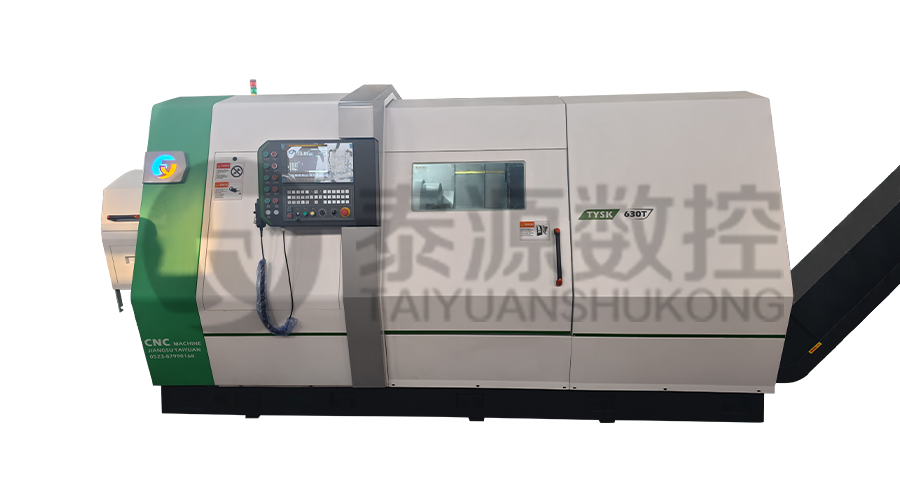 Model:TYSK-630T Drill Pipe, Joint & Coupling Lathe
The machine adopts a FANUC CNC system with stable processing accuracy and flexible programming functions to ensure that the processed parts meet strict industry standards. The high torque and heavy-load design can cope with long-term continuous work and has strong durability.
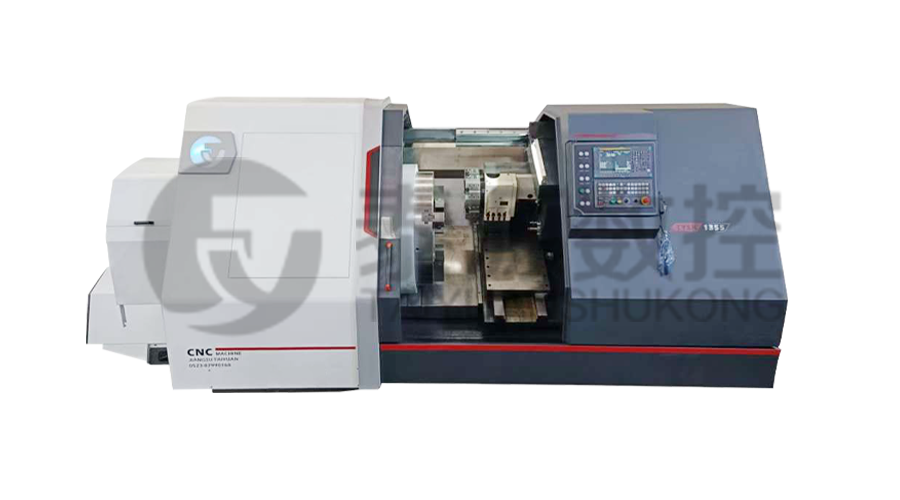 Model:TYSK-1355 Oil Pipe Processing Lathe
The machine adopts a FANUC CNC system with stable processing accuracy and flexible programming functions to ensure that the processed parts meet strict industry standards. The high torque and heavy-load design can cope with long-term continuous work and has strong durability.
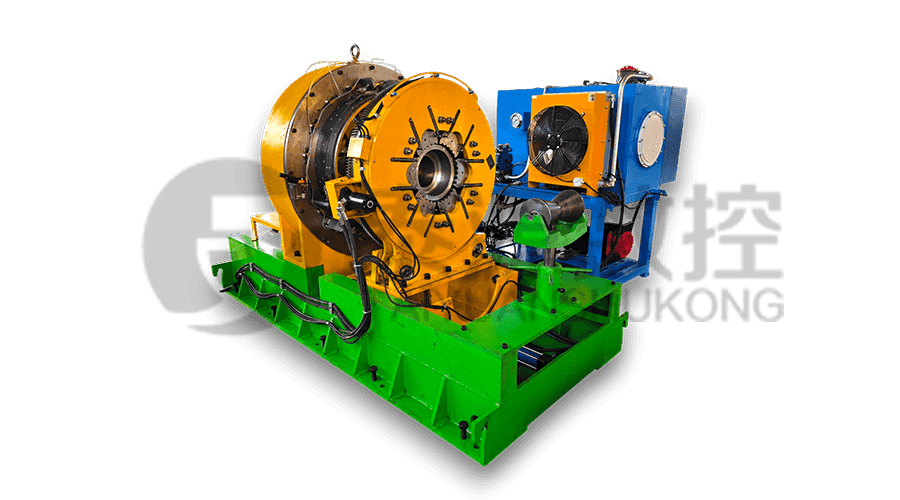 Series:TYSK-NKJ Screw-on machine/Casing and tubing coupling bucking unit
The machine uses a hydraulic motor, mechanical floating mechanism, and real-time torque detection, adapts to material bending, and prevents material deformation. Auxiliary machines are configured to help with semi-automation.
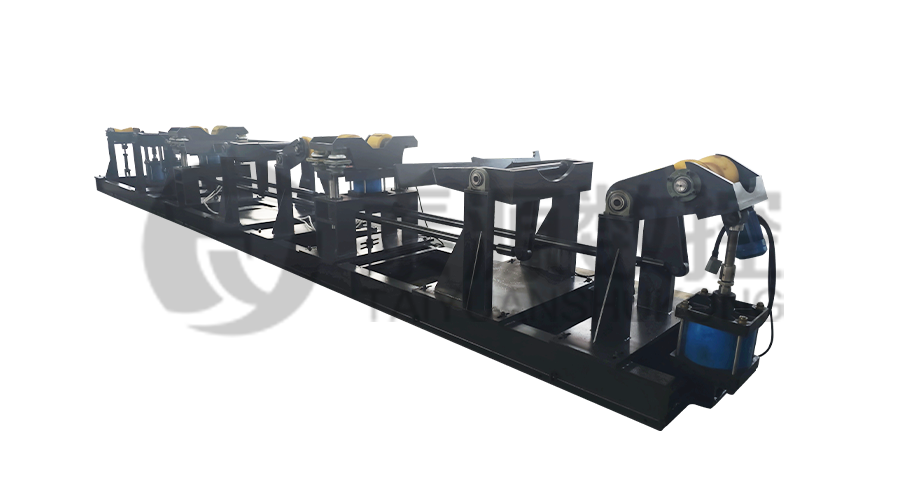 Long, heavy material solutions Automatic loading and unloading mechanism for pipe threading
The special flexible support mode can effectively reduce the influence of workpiece bending on processing and improve the yield. Strictly matching with our pipe threading lathe.
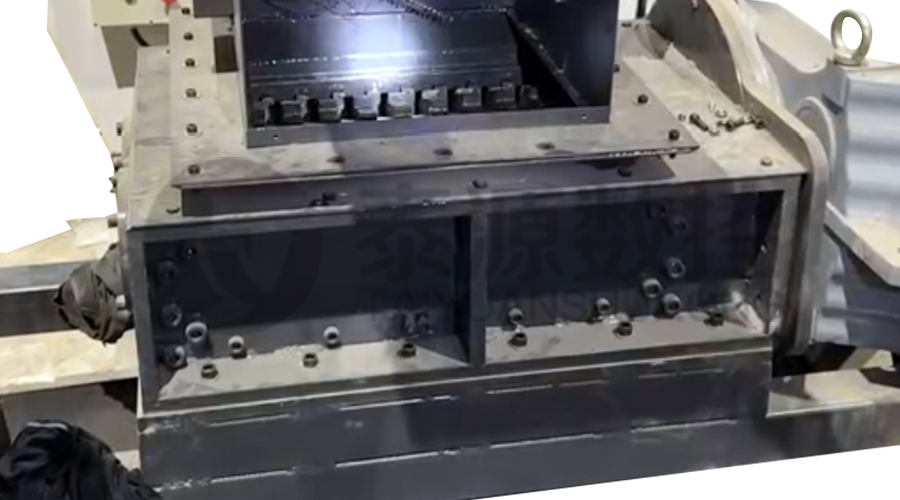 Modular Iron Chip Crusher High strength crusher for chip
The blades are made of high-strength materials and reasonably placed at the exit of the chip extractor to break the clump iron chips.Reduce the risk of rollback and improve waste frame utilization.
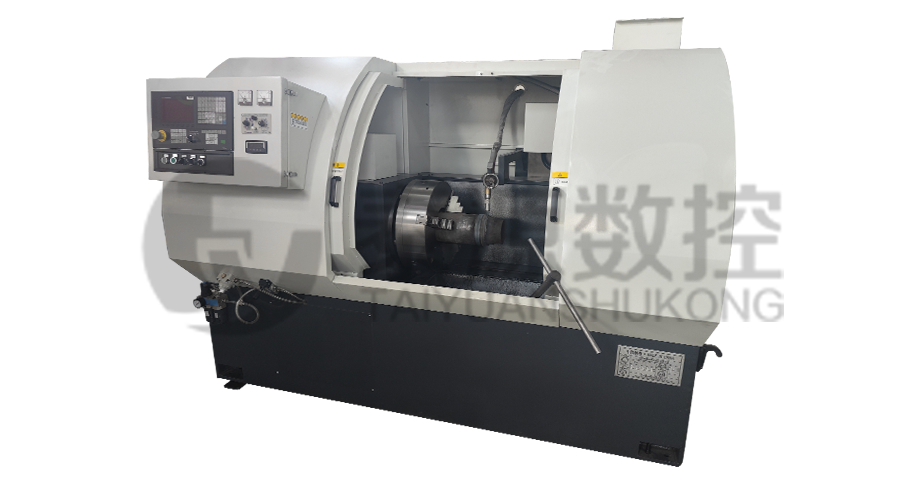 Series:TYSK-HB Semi-automatic wear-resistant band welder
Applicable to ARNCO 100XT, 200XT, 300XT. Support φ1.2-2.0 cored or solid wire surfacing welding.Can be equipped with single gun spray welding and double gun spray welding two ways. Support PLC or CNC system control.
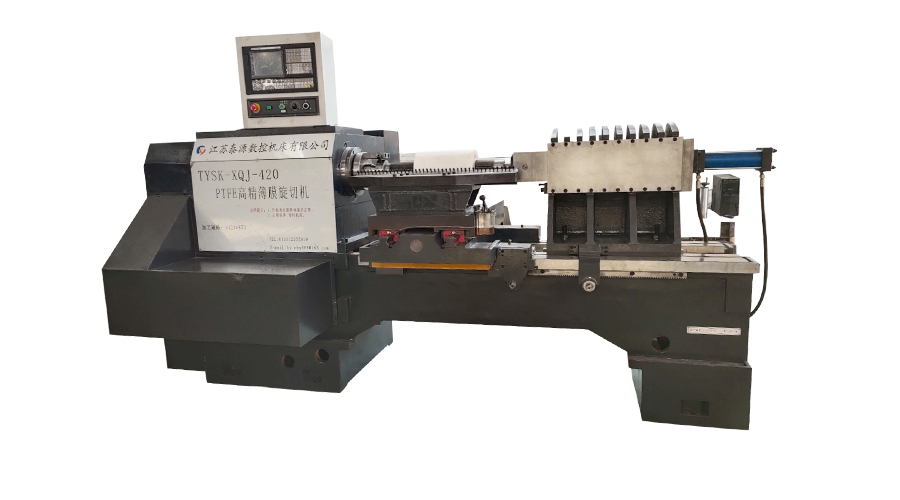 Model:TYSK-XQJ-550 Medium & Large PTFE Film Skiving Machine
Designed to process blanks with a maximum diameter of 550 mm and a maximum length of 1000 mm. We can also customize according to the needs of users. Friendly change speed and thickness with CNC.
