



 English
  عربى
عربى  中文简体
中文简体

Reminder information

Jun 18, 2026
Content
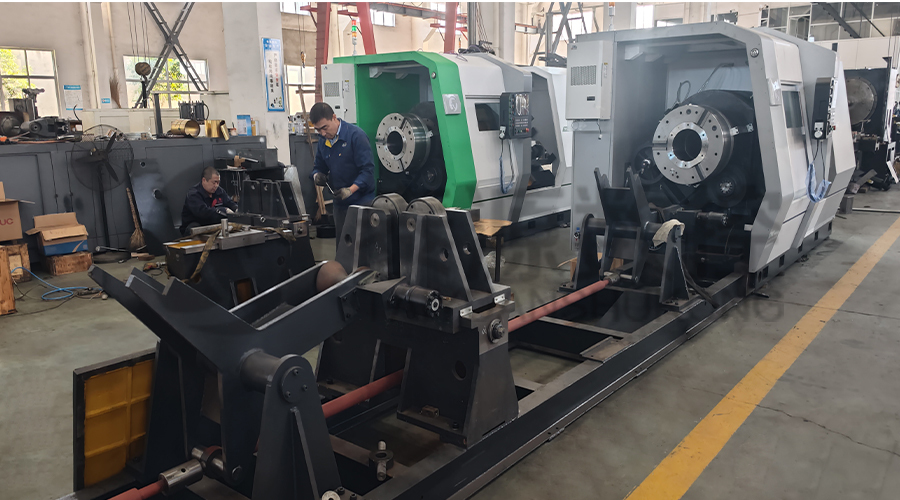
An Oil Drill Pipe, Joint & Coupling Lathe Machine is the backbone of precision oilfield tubular machining — purpose-engineered to cut, thread, and finish the connections that keep an entire drill string intact under thousands of feet of rock, pressure, and torsional load. When a coupling threads fail at depth, the cost is not just the lost pipe — it is the rig day rate, the fishing operation, and in worst cases, the well itself.
The primary function of a drill pipe coupling lathe is to machine the mating surfaces and threaded connections on tubular goods used in oil and gas drilling. These connections — box ends, pin ends, couplings, and tool joints — must conform to exact API or proprietary thread profiles to ensure leak-free makeup torque and structural integrity under dynamic drilling loads that can exceed 500,000 lbs of tension combined with cyclic bending stress.
Machining API round, buttress, or proprietary premium thread forms on coupling OD and pipe pin ends to exact pitch, taper, and lead tolerances.
Precision-facing the sealing shoulder on premium connections to achieve metal-to-metal seal geometry within 0.002mm flatness tolerance.
Rough and finish turning of coupling and tool joint outer and inner diameters to specified wall thickness, concentricity, and surface finish Ra values.
Restoring worn or damaged API connections on used drill pipe and couplings to return tubular goods to service-ready condition and full API compliance.
Internal taper machining for box-end connections and coupling internal threads, maintaining concentricity with the pipe axis to within 0.01mm runout.
Final lead-in chamfer cutting and burr removal on all threaded ends to prevent thread damage during makeup and transportation.
Thread accuracy in oilfield tubular machining is not a manufacturing preference — it is a safety and regulatory requirement. API Spec 5B and 5CT define allowable tolerances for pitch diameter, taper per foot, lead, and thread height that must be verified on every machined connection. A purpose-built coupling lathe achieves this through a combination of structural rigidity, precision spindle geometry, and controlled toolpath execution.
Thread accuracy begins with spindle runout below 0.005mm TIR and bed straightness within 0.01mm per meter — any flex or vibration in the machine structure translates directly into pitch and taper error in the finished thread. This is why oilfield coupling lathes use hardened and ground box-section beds rather than the fabricated steel frames used in general-purpose turning centers.
On CNC-configured machines, the threading cycle is controlled by a synchronized encoder on the spindle feeding precise positional data to the Z-axis servo — allowing the tool to re-engage the thread at exactly the same angular position on each pass. This synchronization maintains lead accuracy across multiple roughing passes and the final finish pass, eliminating the cumulative pitch error that manual threading introduces when re-engaging a cut.
| Accuracy Parameter | API 5B Tolerance | CNC Lathe Achievable | Verification Method |
| Thread Pitch Diameter | +/- 0.076mm | +/- 0.010mm | API thread gauge set |
| Taper per Foot | +/- 1/32 in/ft | +/- 1/128 in/ft | Taper gauge / CMM |
| Thread Lead | +/- 0.076mm / 25mm | +/- 0.008mm / 25mm | Lead comparator |
| Spindle Runout (TIR) | Not specified | < 0.005mm | Dial indicator at chuck |
| Surface Finish (Ra) | 3.2 micron max | 0.8–1.6 micron | Profilometer |
Oilfield tubular goods span a wide range of diameters, grades, and connection types — a purpose-built drill pipe lathe must accommodate the full spectrum of common sizes without compromising accuracy at either end of the range.
Selecting the correct lathe begins with the largest workpiece diameter and length the machine will regularly process — both determine the minimum swing and distance between centers required. Beyond geometry, four technical criteria separate adequate machines from purpose-correct oilfield lathes.
Must exceed the largest coupling or tool joint OD by a safe working margin. For 6-5/8 in drill pipe, a 630mm (24.8 in) swing minimum is required. HWDP and drill collar work demands 800mm+.
The spindle through-bore must pass the pipe body — typically 130–180mm for standard drill pipe. Chuck jaw travel must accommodate both the narrow pipe body and the wider tool joint without re-chucking.
Must cover the full range of API thread pitches — 3.5 TPI through 13 TPI for common connections — without change gears or external attachments. CNC threading eliminates this constraint entirely.
Drill pipe bodies range from 28 to 45 feet. For threading individual joints after cutting, a 3–5 meter between-centers distance is practical. Steady rests prevent pipe deflection and chatter at extended lengths.
A complete CNC coupling machining cycle on a purpose-built lathe follows a defined sequence that maintains dimensional control at every stage, from raw forging to finished gauged connection.
The coupling forging or bar stock is chucked in the 3- or 4-jaw chuck, indicated for concentricity, and faced square on both ends to establish datum surfaces for all subsequent operations.
The coupling OD is roughed to within 1.5–2mm of finished diameter in one or two passes, removing scale and establishing round stock. Carbide inserts rated for interrupted cuts handle forging scale without chipping.
The coupling bore is rough-drilled then finish-bored to the API internal taper specification. CNC Z-axis interpolation maintains taper linearity along the full bore length in a single synchronized pass.
The thread cycle is executed with a single-point threading tool, typically requiring 8–14 passes from rough to finish. The CNC controller maintains spindle-to-feed synchronization to 0.001-degree resolution, ensuring lead accuracy on every pass.
The coupling is reversed in the chuck. A previously machined thread serves as the datum for re-chucking concentricity. The second end repeats steps 3 and 4, with the CNC program mirroring the first-end thread program.
The OD is finish-turned to specified diameter and surface finish, and lead-in chamfers are cut on both ends. Final part dimensions are verified with micrometers and API gauge sets before the coupling is released to inspection.
Thread quality in oilfield coupling machining is the product of machine condition, tooling selection, cutting parameters, and a systematic gauging protocol applied to every finished connection — not to random samples. A single out-of-tolerance coupling that passes to the field represents an uncontrolled failure risk in the drill string.
From single-point threading of API connections to full CNC coupling production cycles, the correct lathe specification determines thread quality, cycle time, and long-term tooling cost across the life of the machine. Explore the Oil Drill Pipe, Joint & Coupling Lathe Machine range and match swing capacity, spindle bore, and threading system to your specific tubular programme.
Related Products
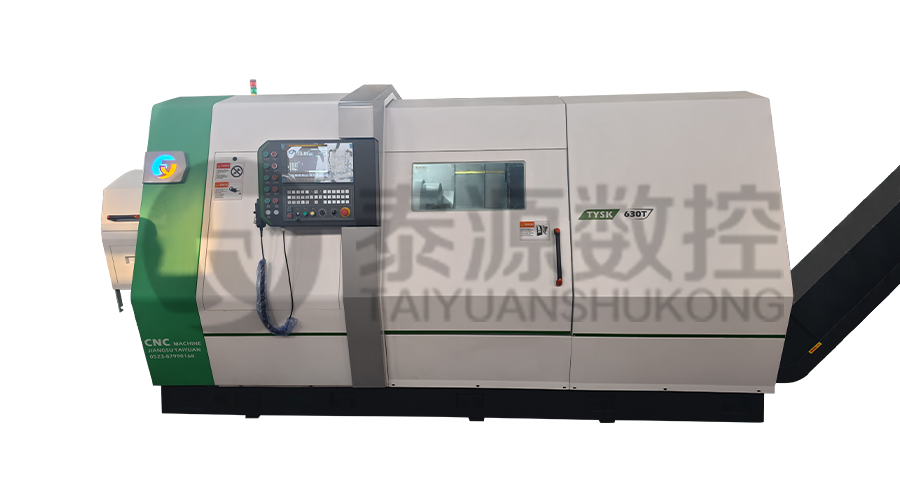 Model:TYSK-630T Drill Pipe, Joint & Coupling Lathe
The machine adopts a FANUC CNC system with stable processing accuracy and flexible programming functions to ensure that the processed parts meet strict industry standards. The high torque and heavy-load design can cope with long-term continuous work and has strong durability.
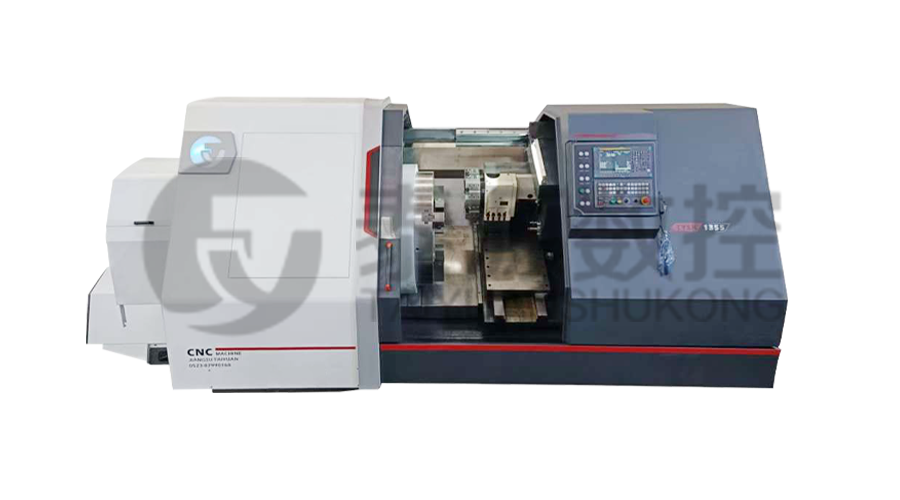 Model:TYSK-1355 Oil Pipe Processing Lathe
The machine adopts a FANUC CNC system with stable processing accuracy and flexible programming functions to ensure that the processed parts meet strict industry standards. The high torque and heavy-load design can cope with long-term continuous work and has strong durability.
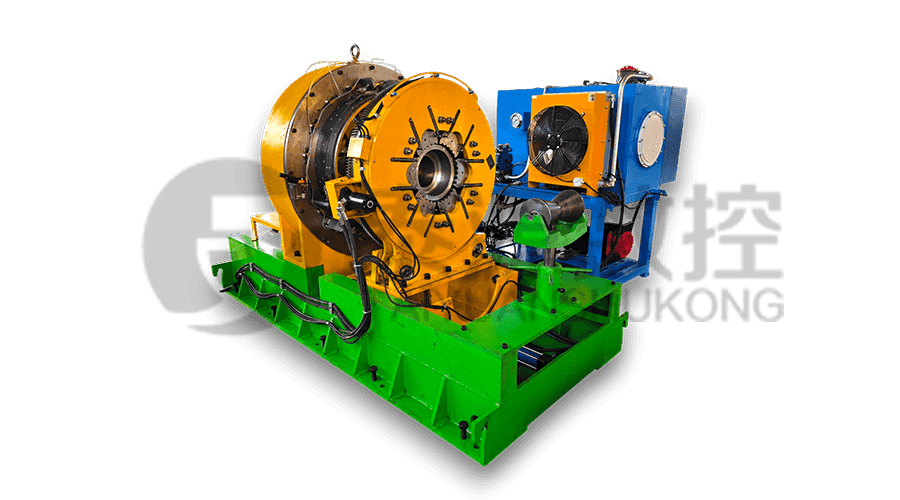 Series:TYSK-NKJ Screw-on machine/Casing and tubing coupling bucking unit
The machine uses a hydraulic motor, mechanical floating mechanism, and real-time torque detection, adapts to material bending, and prevents material deformation. Auxiliary machines are configured to help with semi-automation.
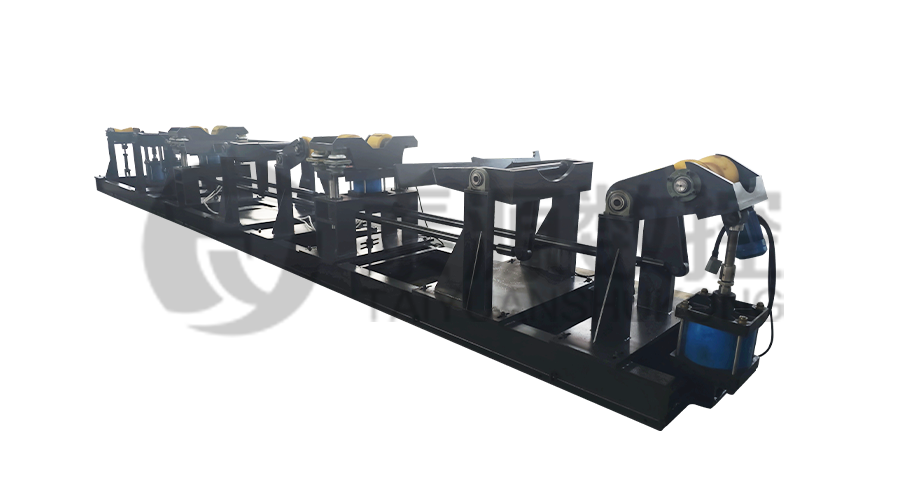 Long, heavy material solutions Automatic loading and unloading mechanism for pipe threading
The special flexible support mode can effectively reduce the influence of workpiece bending on processing and improve the yield. Strictly matching with our pipe threading lathe.
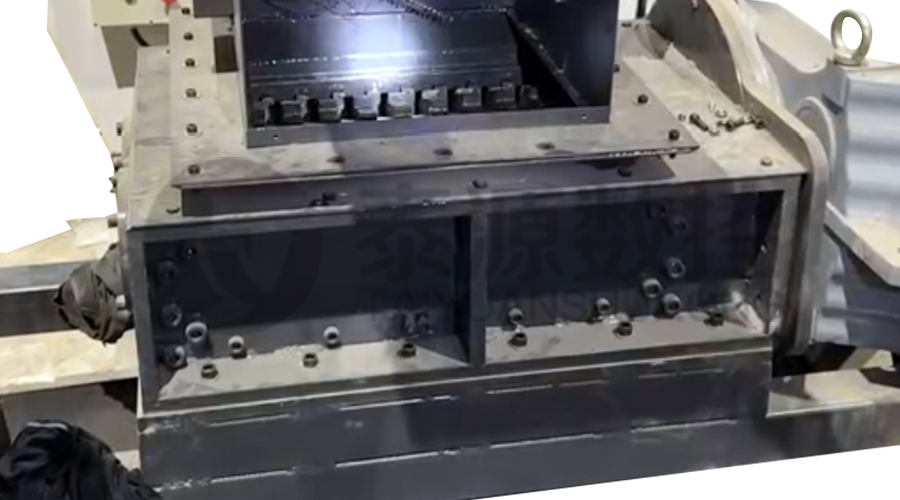 Modular Iron Chip Crusher High strength crusher for chip
The blades are made of high-strength materials and reasonably placed at the exit of the chip extractor to break the clump iron chips.Reduce the risk of rollback and improve waste frame utilization.
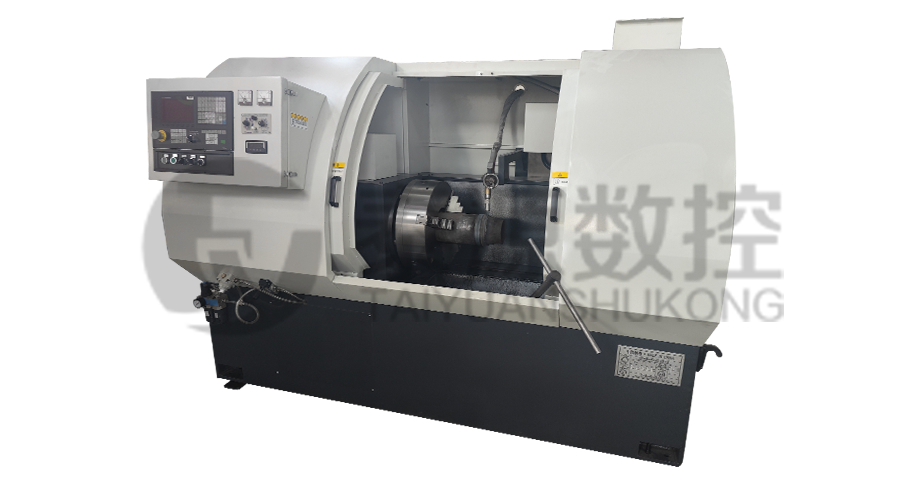 Series:TYSK-HB Semi-automatic wear-resistant band welder
Applicable to ARNCO 100XT, 200XT, 300XT. Support φ1.2-2.0 cored or solid wire surfacing welding.Can be equipped with single gun spray welding and double gun spray welding two ways. Support PLC or CNC system control.
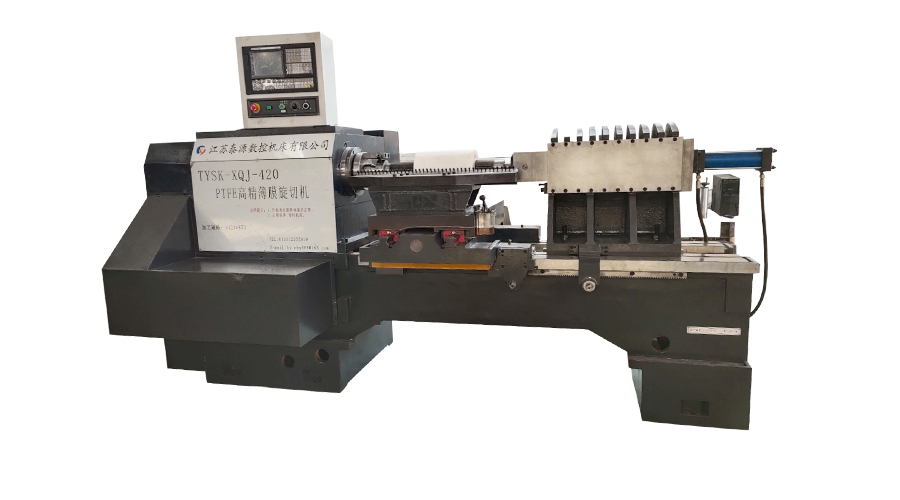 Model:TYSK-XQJ-550 Medium & Large PTFE Film Skiving Machine
Designed to process blanks with a maximum diameter of 550 mm and a maximum length of 1000 mm. We can also customize according to the needs of users. Friendly change speed and thickness with CNC.
