



 English
  عربى
عربى  中文简体
中文简体

Reminder information

Jun 04, 2026
Content
A semi-automatic wear-resistant band welder machine is a purpose-built industrial welding system designed to join metal strips, wear-resistant alloy bands, and conveyor components with consistent weld quality at production-line speeds. Unlike manual welding, the semi-automatic configuration automates the clamping, feed, and weld cycle while keeping a human operator in control of positioning and quality oversight — delivering a measurable balance between throughput and precision that neither fully manual nor fully automated systems can match at equivalent cost.
A band welder machine is an industrial system that uses resistance, laser, or arc welding technology to fuse metal bands — typically wear-resistant alloy strips — into continuous lengths or onto substrate surfaces. The machine holds the workpiece under controlled clamping pressure, advances it at a preset feed rate, and executes the weld cycle automatically, producing a repeatable heat-affected zone and fusion depth that manual methods cannot achieve consistently.
The wear-resistant designation refers specifically to machines designed for chromium carbide, manganese steel, and hard-facing alloy bands used in abrasion-intensive environments. These materials require precise preheat control and post-weld cooling management to prevent cracking — capabilities built into the machine's programmable controller rather than left to operator skill.
Band welding efficiency is measured across three dimensions: deposition rate, operator workload, and weld consistency. On all three, a semi-automatic wear-resistant band welder machine outperforms manual alternatives by margins that directly impact production economics.
| Metric | Manual SMAW | Semi-Auto Band Welder | Improvement |
| Deposition rate (kg/hr) | 0.8–1.5 | 2.5–6.0 | 3–5x faster |
| Weld bead consistency | Operator-dependent | Programmed, repeatable | 60–80% fewer defects |
| Operator fatigue factor | High — continuous arc holding | Low — machine holds arc | Reduces RSI risk |
| Material utilization | 70–75% | 88–94% | 15–20% less waste |
| Setup time per run | 5–10 min | 8–15 min (first run) | Amortizes over long runs |
The efficiency advantage is most pronounced on long continuous welds of 500mm or more. For short tack welds or complex geometry work, the setup overhead of the semi-automatic system narrows the productivity gap. Most high-volume operations break even on setup costs at run lengths exceeding 200mm per weld pass.
Band welder machines are deployed wherever metal surfaces face abrasion, impact, or sliding wear severe enough to require hard-facing or wear-strip reinforcement. The six primary industries and their specific applications are:
Selecting a band welding machine requires matching five technical parameters to the production environment. Purchasing based on price alone — without verifying material compatibility, duty cycle, and output current range — is the primary cause of underperforming installations in heavy industry.
Chromium carbide bands (Cr content 25–35%) require preheat to 150–250°C and post-weld cooling control. Manganese steel bands require water quench sequencing. Confirm the machine's temperature management capability matches the alloy specification before any other evaluation.
Band thickness from 3mm to 8mm requires output currents of 200–600A depending on alloy conductivity. Verify the machine's rated output at 100% duty cycle — not peak output — as thermal derating at sustained high currents is the most common cause of undersized machine selection.
The clamping system must accommodate the full width range of bands used in production — typically 30mm to 150mm for standard wear-strip applications. Roller feed mechanisms with adjustable pressure settings handle variable-thickness bands without slip or marking; fixed-pinch designs do not.
A PLC-controlled machine with parameter storage for at least 20 weld programs reduces setup time on repeat jobs to under 2 minutes. Analog-dial machines require full parameter re-entry per job, adding 8–15 minutes of non-productive time per changeover in mixed-production environments.
Industrial band welding applications typically require 60–80% duty cycle at rated current. Air-cooled machines are sufficient up to 400A at 60% duty cycle; water-cooled torch systems are mandatory for sustained operation above 500A. Confirm cooling specification before committing to a model.
In a semi-automatic band welder machine, the operator manually positions the workpiece and initiates each weld cycle; the machine then controls arc parameters, feed rate, and arc termination automatically. A fully automatic system adds a robotic or servo-driven positioning system that handles workpiece placement without operator input. Semi-automatic configurations cost 40–70% less than equivalent fully automatic systems and remain the standard for variable-geometry or low-to-medium volume production where full automation cannot be justified economically.
Service life depends on the abrasive environment and band alloy selection. Chromium carbide bands applied to mining equipment bucket lips typically extend component life by 3 to 5 times compared to bare steel. In cement grinding applications, hard-faced surfaces using Cr-C bands achieve 8,000 to 12,000 operating hours before refacing is required, versus 1,500 to 2,500 hours for unprotected cast iron or mild steel surfaces.
Yes, with appropriate tooling. Flat plate applications use a standard straight-feed clamping bed. Curved surfaces — such as roll shells, drum liners, and cone segments — require a rotary positioner attachment that rotates the workpiece at a controlled speed synchronized to the machine's feed rate. Most industrial band welder models accept optional rotary positioner accessories as a field-installable upgrade rather than requiring a separate machine.
Routine maintenance covers four areas: drive roller inspection and replacement every 500–800 operating hours (wear rate depends on band hardness), torch contact tip replacement every 20–40 hours of arc time, cooling water quality monitoring on water-cooled systems (conductivity below 50 µS/cm), and PLC parameter backup after any programming change. Major overhaul intervals for the power source and drive mechanism are typically 3,000 to 5,000 hours under normal industrial duty cycles.
Related Products
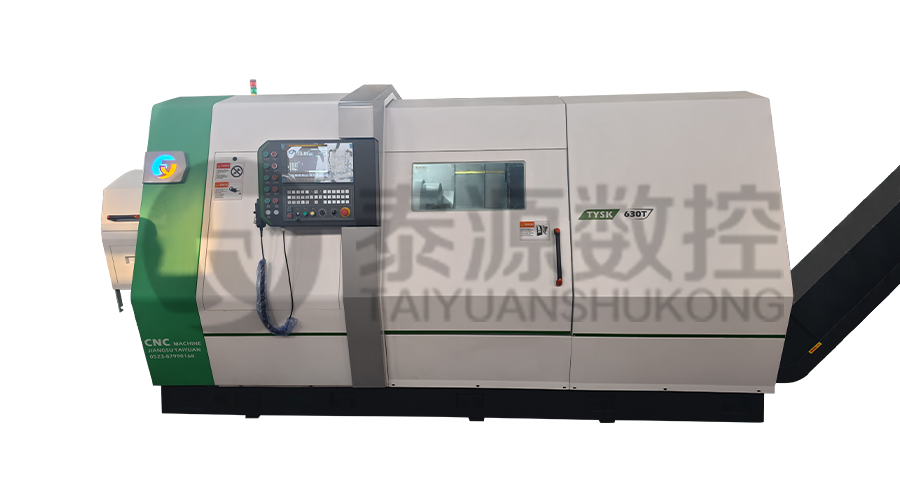 Model:TYSK-630T Drill Pipe, Joint & Coupling Lathe
The machine adopts a FANUC CNC system with stable processing accuracy and flexible programming functions to ensure that the processed parts meet strict industry standards. The high torque and heavy-load design can cope with long-term continuous work and has strong durability.
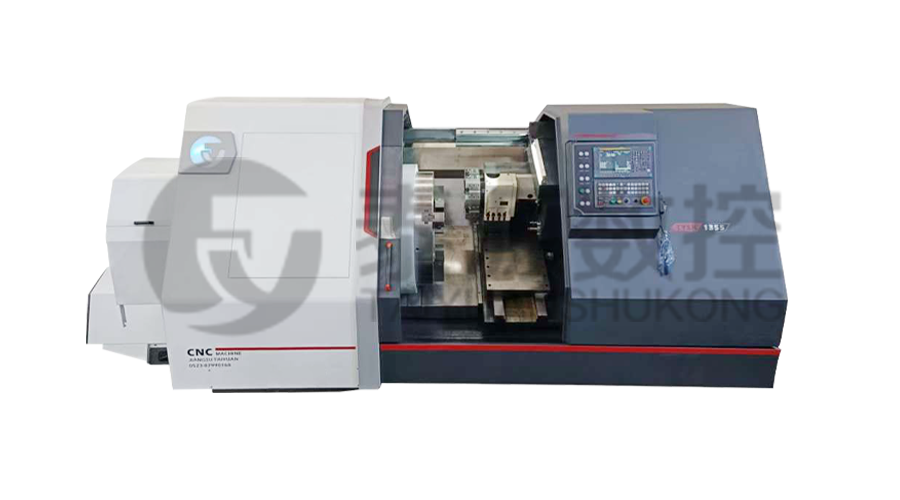 Model:TYSK-1355 Oil Pipe Processing Lathe
The machine adopts a FANUC CNC system with stable processing accuracy and flexible programming functions to ensure that the processed parts meet strict industry standards. The high torque and heavy-load design can cope with long-term continuous work and has strong durability.
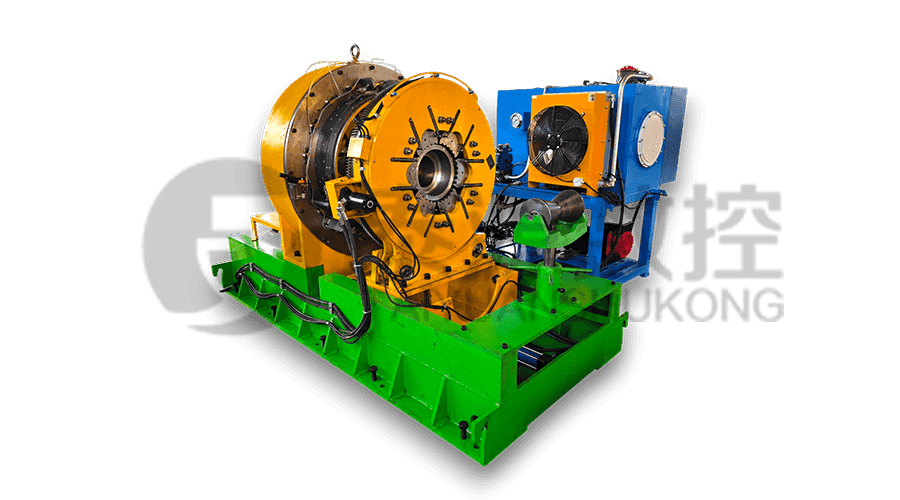 Series:TYSK-NKJ Screw-on machine/Casing and tubing coupling bucking unit
The machine uses a hydraulic motor, mechanical floating mechanism, and real-time torque detection, adapts to material bending, and prevents material deformation. Auxiliary machines are configured to help with semi-automation.
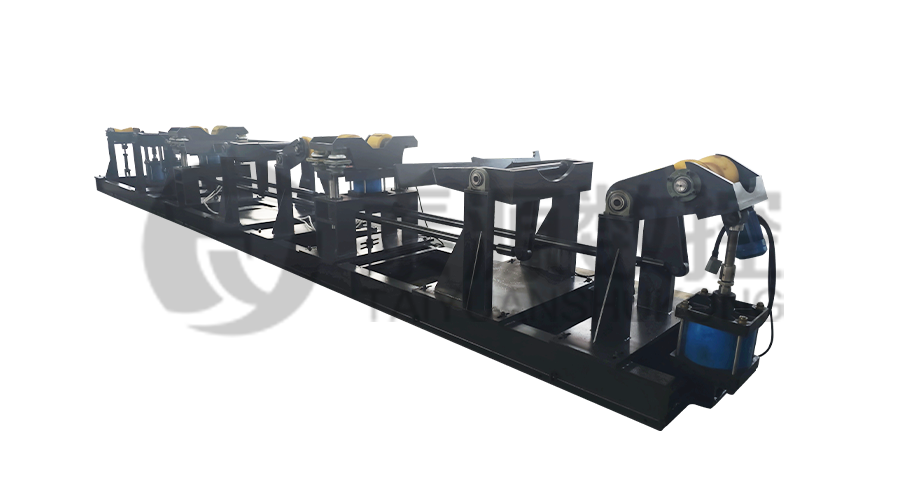 Long, heavy material solutions Automatic loading and unloading mechanism for pipe threading
The special flexible support mode can effectively reduce the influence of workpiece bending on processing and improve the yield. Strictly matching with our pipe threading lathe.
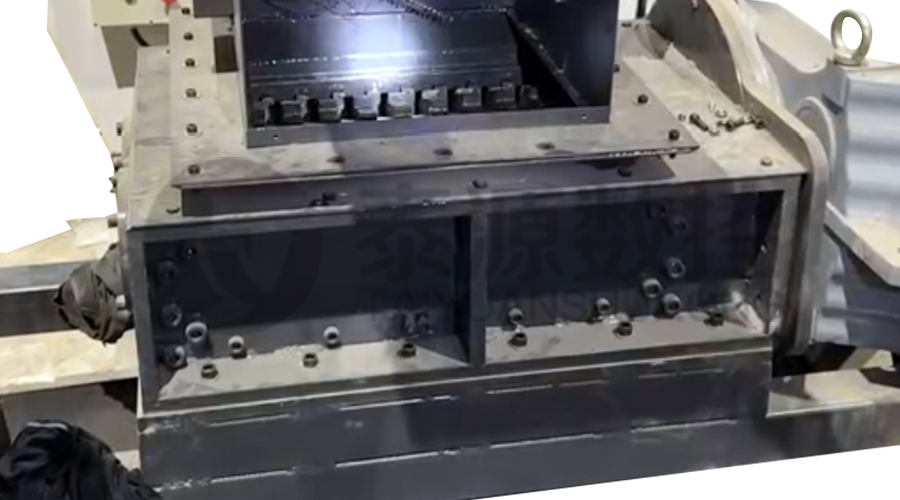
Modular Iron Chip Crusher High strength crusher for chip
The blades are made of high-strength materials and reasonably placed at the exit of the chip extractor to break the clump iron chips.Reduce the risk of rollback and improve waste frame utilization.
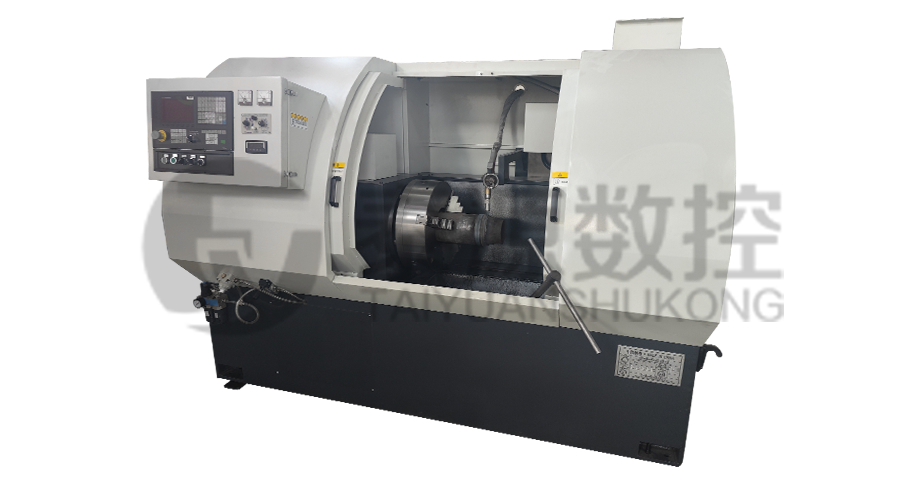 Series:TYSK-HB Semi-automatic wear-resistant band welder
Applicable to ARNCO 100XT, 200XT, 300XT. Support φ1.2-2.0 cored or solid wire surfacing welding.Can be equipped with single gun spray welding and double gun spray welding two ways. Support PLC or CNC system control.
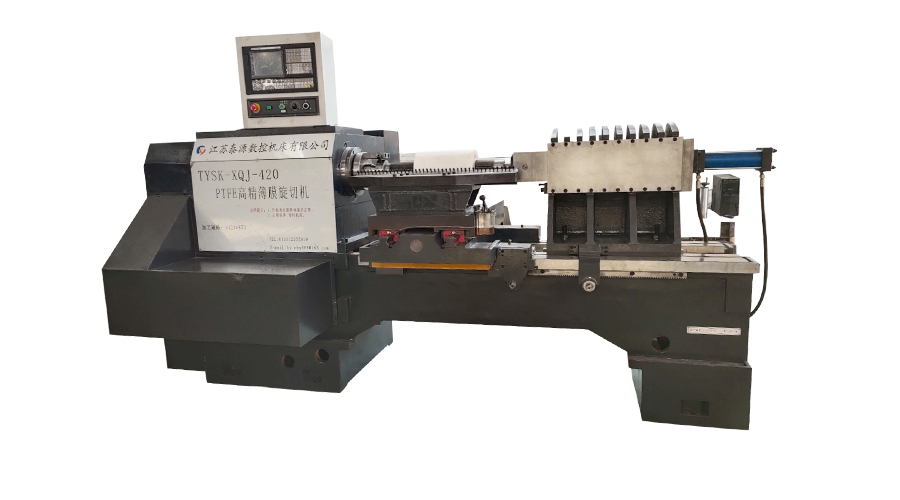 Model:TYSK-XQJ-550 Medium & Large PTFE Film Skiving Machine
Designed to process blanks with a maximum diameter of 550 mm and a maximum length of 1000 mm. We can also customize according to the needs of users. Friendly change speed and thickness with CNC.
